
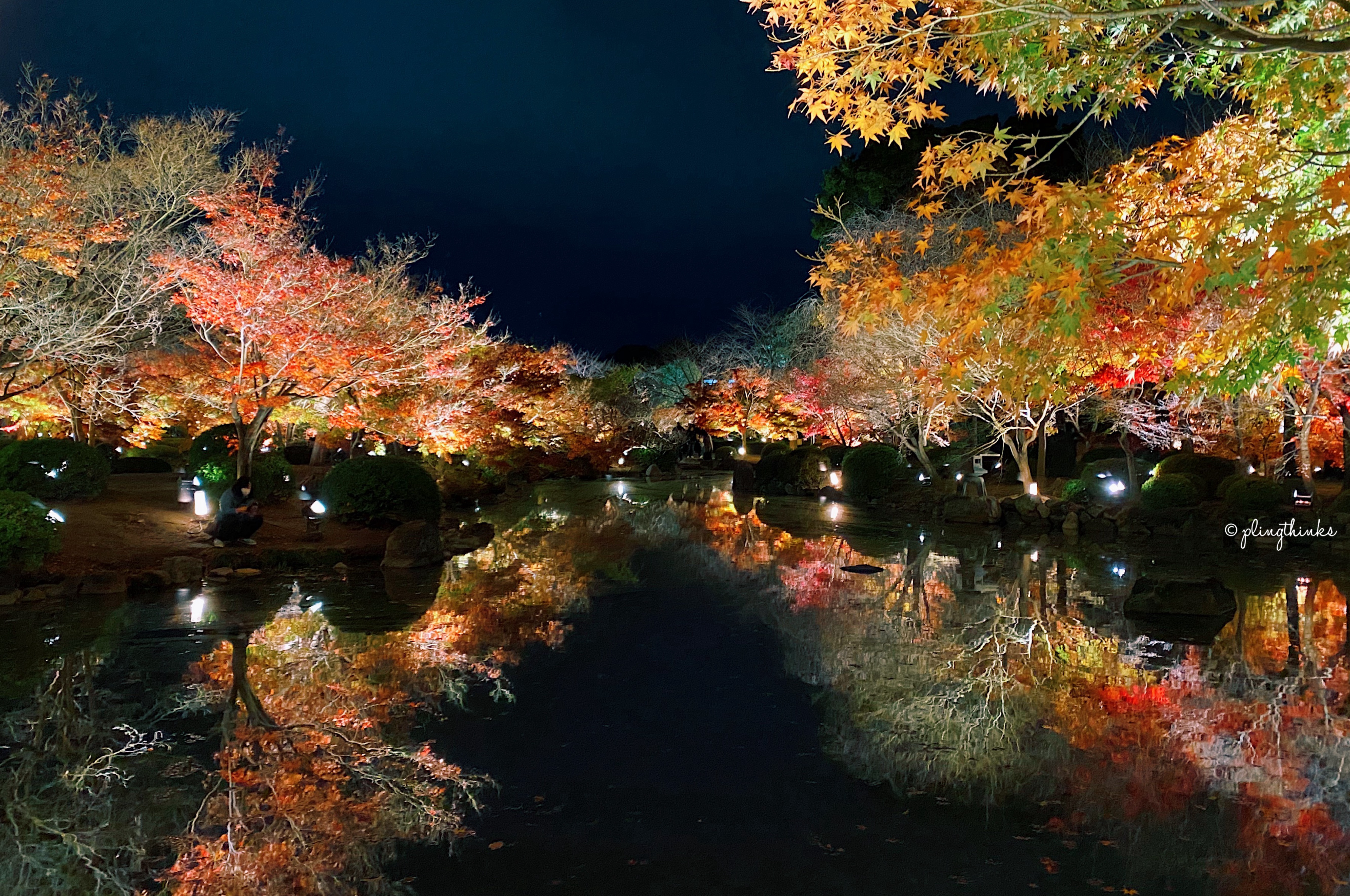
As darkness falls over Kyoto each autumn, Toji Temple (東寺) — a UNESCO World Heritage Site and one of the city’s most treasured cultural landmarks — transforms into one of Japan’s most breathtaking night illumination experiences. The temple’s iconic five-storey pagoda — the tallest wooden tower in Japan at 54.8 metres — is reflected in a perfect mirror image across the surrounding pond, bathed in warm golden light against the deep night sky.
Whether you’re planning your first Japan autumn travel itinerary or returning for Kyoto’s legendary fall foliage season or momijiari (紅葉狩り), these 5 experiences in Toji Temple after dark will transform your visit, perfect as an after-dinner activity, into something truly unforgettable.
1. Reflection of Japan’s Tallest Wooden Pagoda After Dark
On a cool autumn night, standing at the edge of Toji Temple’s illuminated pond, the reflection of Japan’s tallest wooden 5-storey pagoda shimmered in the still water below — and every visitor around us fell into a hushed, collective awe. We hadn’t wandered far from the entrance before this breathtaking sight stopped us in our tracks.

Set against the glow of red, orange, yellow, and green Japanese maple leaves, the 54.8-metre pagoda rose into the night sky with quiet magnificence — its ancient timber structure glowing warm gold against the darkness. From every angle around the pond, a different composition revealed itself: the full pagoda reflected in near-perfect symmetry in the glassy water, stone bridge and sculpted hedges lending depth to the scene, and the subtle ripple of mirrored light dancing across the surface with the gentlest breeze.


Arrive early in the evening before the crowds thicken, and take your time moving slowly around the perimeter of the pond. Each step shifted the pagoda’s reflection into an entirely new composition and every single one worth photographing.
2. Four Centuries of Timber Meet Autumn Colours
Built in 826 AD under the order of one of Japan’s most famous religious figures Buddhist Monk Kūkai (空海) — also known as Kōbō-Daishi (弘法大師) — and reconstructed in its current form in 1644, this UNESCO World Heritage structure has stood watch over Kyoto for nearly four centuries.
Its architectural grandeur was best appreciated not in reflection, but in presence. Without the reflection, a different story unfolded. The five-storey pagoda revealed what the reflection could not — the extraordinary detail of its construction.

From the ground level, looking upwards from the base, the pagoda rose with remarkable deliberateness — each of its 5 tiers slightly smaller than the last, the deeply carved eaves, the layered rooflines curving gently skyward, its ancient timber structure glowing with a warmth that feels almost amber — every beam, every curved roofline, every carefully constructed tier catching the light in ways that revealed the extraordinary craftsmanship of its Edo-period construction.

But it was the Japanese maple canopy that elevated this from remarkable to breathtaking. At peak koyo (紅葉), the maple leaves pressed their most vivid colours — deep crimson, burnt orange, luminous gold, and the last defiant greens of the season — directly into the frame of the pagoda’s upper storeys. The branches reached and curled around the structure naturally, as though they had grown expressly to frame it. The illumination catches every layer simultaneously: the warm glow of the pagoda’s timber, the blazing maple canopy, and the deep indigo of the Kyoto night sky above — three distinct worlds stacked beautifully into one frame.

This composition felt both ancient and surreal. Move slowly around the structure, let the maple branches shift into the foreground, and allow the pagoda’s upper storeys to emerge amongst the canopy.
Special access to the 1st level of the 5-storey pagoda are open during the autumn night illumination from 31 October to 13 December 2026 for those who are interested to look at a different view. Sadly, when we visited, there weren’t such access. Do check on-site with the temple staff.
While the wooden pagoda can be admired day and night, yet under the night illumination, it felt less like a historical monument and more like something conjured from a dream — ancient, luminous, and utterly alive.
3. Evening Stroll Under Kyoto’s Autumn Colours
We elevated our after-dinner experience with a serene evening stroll beneath illuminated autumn foliage at Toji Temple. What made the evening stroll truly memorable was the interplay between stillness and movement.


Japanese maple leaves swayed softly in the cool autumn breeze — catching the light and releasing it — creating a quiet, hypnotic rhythm that drew us deeper into its dance. Gentle gusts shifted the canopy, and the colours rearranged themselves into entirely new compositions, as if nature itself was curating the experience for every visitor who passed beneath.


Under carefully positioned night lights, every leaf was transformed — greens that had not yet surrendered to the season glow with an almost translucent luminescence, while the yellows, oranges, and deep crimson reds burned with a warmth that felt impossibly vivid against the dark Kyoto sky. Looking up, the canopy above became a living mosaic of colour — layered, luminous, and in gentle motion.


Toji Temple’s illuminated Japanese maple trees are nothing short of spectacular in peak autumn season. The illuminated pathway wound through the grounds, inviting us to linger and take in Kyoto’s koyo — the celebrated tradition of Japanese autumn leaf viewing. We strolled with our heads tilted upward, phones raised, pausing every now and then to take in a particularly breathtaking bursts of colour caught in the light.

4. Savour Warm Matcha and Dango

We hadn’t planned to stop. But the warm glow of a humble tea stand tucked quietly within the temple grounds, the smell of dango on grill, and the welcoming sight of spacious benches draped in a rich red made the decision for us — and it turned out to be a much-needed pause, a quiet moment to take everything in.
For centuries, matcha and dango have been inseparable from Japan’s temple culture. Dango 団子 — soft, chewy rice flour dumplings skewered and lightly grilled — are among Japan’s oldest and most iconic street snacks, with origins dating back to the Heian period when offerings of rice dumplings were made at temples and shrines. Paired with a cup of freshly prepared matcha 抹茶, bitter and smooth in equal measure, the combination is one satisfying pairing.


The matcha arrived warm and slightly bitter, its earthy depth a perfect counterpoint to the soft, sweet chewiness of the Sanshoku dango (三色団子) — 3 rice flour dumplings skewered and still warm from the grill.

With the pagoda glowing in the distance and the maple canopy blazing red and gold all around, the quiet hum of the temple at night wrapped itself around everything. At Toji Temple’s autumn night illumination, matcha and dango were not just a snack — they were part of the experience itself, and one we would not skip.
5. The Kondo, The Kodo, and Their Treasures

As the evening at Toji Temple drew to a close, a quiet walk toward the Kondo (金堂) — the temple’s Golden Hall and its most sacred structure — offers a final, contemplative moment before you step back through the gates and into the night.
The Kondo is a designated National Treasure of Japan — a distinction it holds alongside the pagoda. Built to enshrine the principal Buddhist deity, it is the spiritual heart of Toji Temple. Inside, 3 of Toji Temple’s most venerated Buddhist figures have presided over prayers and offerings for centuries. When we visited, photography was not permitted inside the hall. So, we left our shoes outside, let our eyes adjust to the darkness, and walked through the hall.

A note for spring visitors
While the cherry blossom trees dotting the Toji Temple grounds sleep quietly through the autumn illumination season, they are worth noting for those planning a spring visit. Toji Temple is home to an iconic weeping cherry tree, Fujizakura (不二桜) believed to be over 120 years old — its overwhelming presence standing at 13m tall, its ancient, gnarled trunk, and wide-spreading branches erupting each April in a magnificent cloud of cherry blossoms. If spring brings you to Kyoto, Toji Temple in sakura season with over 200 cherry trees in full bloom and its sakura night illumination is a visit well worth adding to your itinerary.
pling thinks…For travellers seeking the best autumn fall foliage illumination in Kyoto, Toji Temple after dark is an unmissable spectacle that captures the ancient soul of Japan at its most magical and a deeply atmospheric experience that stays long after the autumn leaves have fallen.

How to get to To-ji Temple
〒601-8473 京都府京都市南区九条町1
1 Kujocho, Minami Ward, Kyoto, 601-8473, Japan
Entry Fees for Autumn Night Illumination: ¥1,000
Entry and tickets are at the Keiga-mon Gate (慶賀門) or East Gate
Autumn Night Illumination 2026:
31 October 2026 to 13 December 2026
18:00 – 21:30 (Last admission at 21:00)

From Kyoto Station:
• Walk 15 mins after exiting via the Hachijo exit (use the map link above to navigate to Toji Temple’s Keiga-mon Gate for entry to autumn leaves night illlumination) or;
• Take bus 71 for 6 stops and alight at stop for Toji-jo Mae. Turn left and walk 2 mins to the East Gate or Keiga-mon Gate of Toji Temple.