
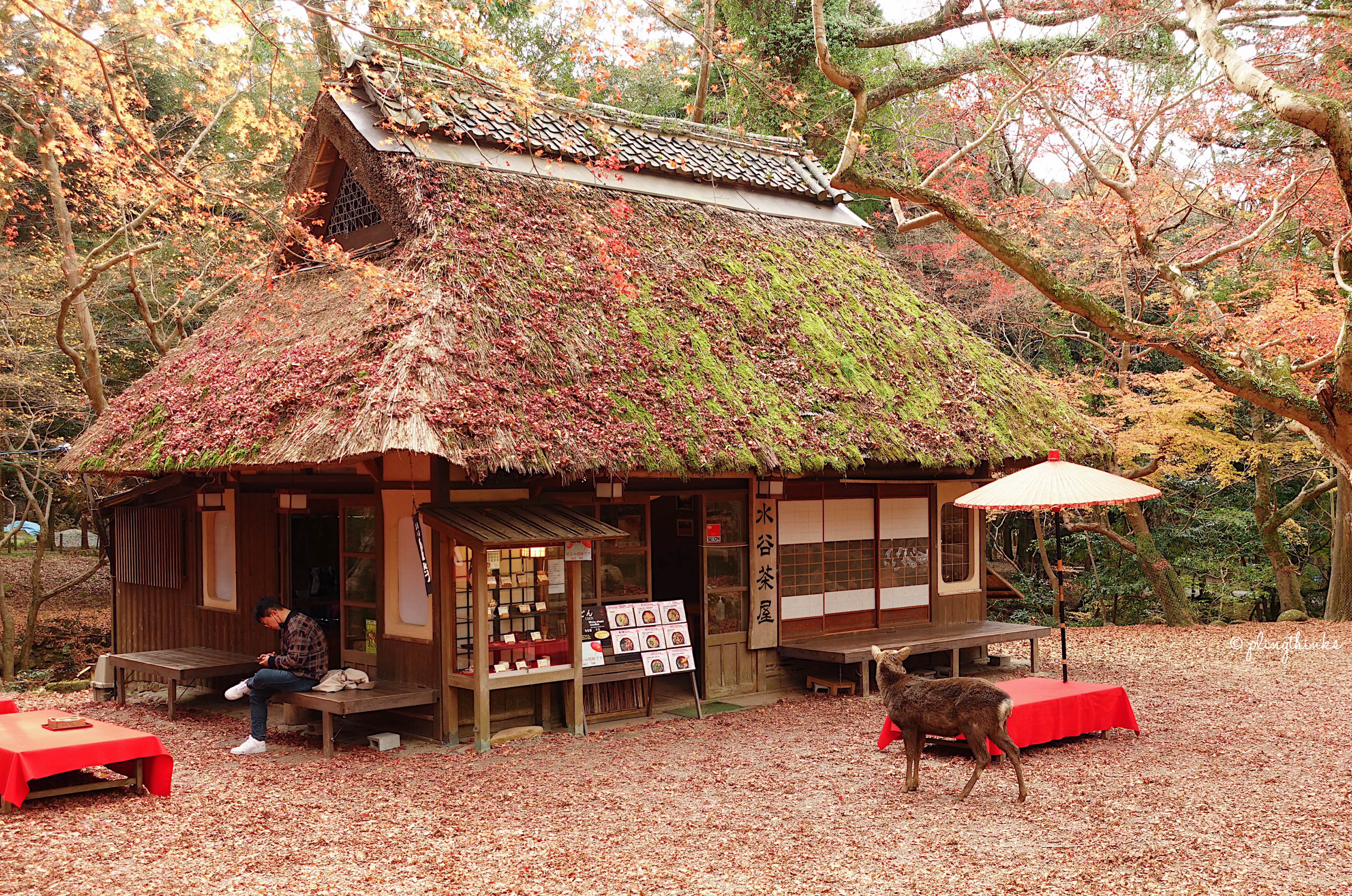
Mizuya Chaya (水谷茶屋) is the kind of place most visitors to Nara Park (奈良公園) never find and those who do, revisit for the mesmerising and rustic beauty it exudes. Tucked off the well-worn tourist trail of Todaiji Temple (東大寺), the deer-cracker vendors, Kasuga Taisha Shrine (春日大社), this Taisho-era thatched roof teahouse has been quietly serving udon and tea since 1948, sitting beside a stream in the woods and offering a dining experience surrounded by the natural beauty of Nara Park, far from souvenir stalls and the main footpaths.
Come autumn, Mizuya Chaya becomes something otherworldly and yet quintessentially Japanese — the moss-covered thatched roof hut, framed by Japanese maple leaves in blazing reds and oranges, igniting the scene in a way that stopped us mid-step. Add to this scene — sika deers that freely roam the grounds with some stationing themselves near outdoor diners or on steps leading towards the teahouse, a bowl of steaming udon under the autumn canopy, and a quieter forest path just beyond lined with stone lanterns that most tourists never reach — and you have one of the most atmospheric lunch stops in all of Japan.
1. Autumn Foliage at Mizuya Chaya
Mizuya Chaya exists in every season, but autumn is when it tips from charming into genuinely arresting. The maples that ringed the clearing didn’t just change colour here — they seemed to perform it, layering crimson over amber over rust until the thatched roof below was framed like something out of a dream.

The mossy thatched roof and the weathered timber, with the surrounding canopy of crimson and amber Japanese maples in autumn, created a composition that felt less like a lunch stop and more like a samurai stage set. The low-roofed modest teahouse set against this backdrop of maple trees and fallen leaves created a restraint so effective that it wasn’t hard to imagine being inside a samurai drama, the whole scene seemingly molten and its illusion almost complete.


2. Deers Around The Teahouse
Sika deers are everywhere across Nara Park, but the ones around Mizuya Chaya carry themselves differently — less frenetic than the groups near the main temple approach; more settled, as though they’ve assessed the area and decided this suits them better, especially during the quiet hours of morning.

A loose cohort of them seemed to regard the teahouse grounds as permanent territory: we found them dozing under Japanese maples in the morning, moving slowly along the forest paths at midday, crossing the red bridge, perching themselves on the stone steps overlooking the teahouse as the morning light filtered through the trees at a slant, or watching senbei-less visitors with disinterest.


What distinguishes this from the more performative deer encounters elsewhere in the park is the atmosphere around it — forest on three sides, a stream nearby, and no souvenir stalls nearby. The deers here feel less like a tourist attraction and more like residents who tolerate visitors on their own terms.


These animals have been considered sacred in Nara for over a thousand years, designated messengers of the shrine deity, and protected as a national natural monument. Around Mizuya Chaya, that history feels oddly plausible.
3. Deers as Your Lunchtime Kakis
The outdoor seating at Mizuya Chaya comes with an important caveat: you are not dining alone.
Choosing the outdoor seating is an invitation to the sika deers who would absolutely join you for lunch. For our non-Singaporean readers, “lunchtime kakis” in the headline refer to lunch companions or lunchtime mates.

Sitting outside on the red benches, we were sharing our table with the deers that have considerable experience extracting food from distracted visitors. This is not a zoo encounter or a managed wildlife experience. These are Nara Park’s famously bold sacred deers, doing what they do best — approaching visitors, nudging their elbows, investigating your tray, and hovering their noses over the food.

There were, of course, surprise and wide eyes when a deer did approach. It was chaotic, hilarious, and completely unique. Why chaos? Read the next paragraph on the special note and you can guess why.
Special note to visitors: Be well aware that the deers should not be consuming food made for humans, which contain salt and other favouring that might be detrimental to these animals. Also, anything white or pale in colour — chopstick wrappers, straws, napkins, and face masks especially — seem like deer crackers to these unsuspecting deers and will be gobbled by them before you can even say “no”. So, keep these hidden away or in your pockets to be thrown safely away later. And please, clear your tray inside the hut after your meal.
The trick is to keep your bowls raised and your camera ready, because the interactions that unfold are the kind of unscripted moments that make travel memorable.

The chaos was good-natured and frequently very funny, especially when a deer zeroed in on the table near ours and we watched someone else’s lunch become a diplomatic incident.

To appease the deers, arm yourself with deer crackers — conveniently available at Mizuya Chaya or from vendors in the main park — so that they will not steal your udon.

4. Simple, Soul-Warming Food

When we visited in autumn, udon in soy sauce based broth was the anchor — bowls arrived hot with toppings that run from wild mountain vegetables and mushroom to tempura prawn and fried chicken. The menu was short and might change with the season, which is as it should be in a teahouse that has been feeding park walkers for the better part of a century. The green tea is self-served and complimentary. You can also ask for a vegetarian menu. Prices range from ¥550 to ¥900.

In the cold weather, the udon was exactly what a long morning of traveling and walking demanded; we ordered zenzai ぜんざい — sweet red bean soup with grilled mochi — to further warm up our bodies and end off our lunch nicely.

Where you choose to sit shapes your experience considerably.
Mizuya Chaya does have limited indoor seats and worth claiming early if you arrive before midday. It’s a compact, simply furnished, and warmly lit space, but eating inside puts a distance between you and the roaming deers, which can be a relief or a disappointment depending on your appetite for wildlife encounters with your udon.

The outdoor benches offer something different entirely. The clearing opened up in front of us — stream to one side, maples overhead, deer drifting in and out of the benches.

In autumn, the view from the outdoor seats rewarded us with leaves banking above in deep reds and yellows, the light shifting through the canopy as time ticked by. Even outside of peak fall foliage season, the scenery made it easy to linger far longer than a bowl of udon technically warranted.


The trade-off, of course, was that the deers knew exactly where and when to approach. Come prepared for company, be careful with these deers (read special note), keep your bowl close, and consider it part of the experience rather than an interruption to it.

The food here won’t be the most technically accomplished meal of your Japan trip, but eaten slowly at an outdoor bench with Nara Park deers moving underneath canopies of Japanese maple leaves, it will very likely be the most atmospheric.
If Mizuya Chaya’s casual, open-air simplicity is a good starting point but you’re craving something more special, Wabunka offers a private tour and kaiseki meal at Kikusuiro (菊水楼), a long-running ryotei (料亭) near Kasuga Taisha (see #5), loved by foreign dignitaries and historical and literary figures alike. Established in 1891 and a Nationally Registered Tangible Cultural Property, Kikusuiro offers multi-course seasonal cuisine. Here, architecture and seasonal food become part of the visit.


5. Ancient Forest Path Beyond Mizuya Chaya
Most visitors photograph Mizuya Chaya from the front and then retrace their steps to rejoin the main park circuit. What they miss then is the area behind the thatched udon teahouse which open onto one of Nara Park’s most evocative walks — an iconic pilgrimage route leading to the vermillion Kasuga Taisha Shrine (春日大社) that stretches for roughly 1 km through ancient woodland, flanked by more than 2,000 most-covered stone lanterns placed at intervals with patient regularity.

What began as a woodland stroll gradually revealed itself as something older — a forest path that was entirely different from busier temple approaches. Kasuga Taisha has occupied these woods since the 8th century, and the closer we walked toward it, the more the forest asserted its ceremonial character. Centuries of moss have settled over the lanterns in varying thicknesses, blurring their carved surfaces into organic shapes. A few leaned with age. None of them seemed in any hurry.


The path was not deserted — deers freely roaming among the lanterns and among the trees, and Japanese school groups on excursions seemed familiar presence here. The deers along this stretch were more indifferent to visitors than their counterparts near the teahouse — grazing without looking up, resting among the tree roots, and weaving along the path of thousands of stone lanterns. There was a warning board on horned deers which we spotted roaming along this path. We even spotted a blind sika deer and attempted to feed it more deer crackers.

In the late afternoon, when low light shone on the moss-covered lanterns at a sideways angle and the shadows between the trees deepened, the kilometre-path between Mizuya Chaya and the shrine took on a quality that was difficult to describe without resorting to cliché. We could understand why this forest has been considered sacred ground for over a millennium.

Right before entering the Path of Thousands of Stone Lanterns, there is an interesting tree, or more accurately, 2 trees melded together at the Mizuya Shrine. Standing at an imposing height of 12.5m, this ibuki (イブキ Juniperus Chinesis) is composed of a big Japanese cedar growing within the airhole of a gigantic Chinese juniper’s stump.
pling thinks…Mizuya Chaya is the kind of place that rewards visitors who are willing to navigate slightly off the route everyone else is taking — not difficult, just deliberate. Within the space of a single lunch stop, you’ll get breathtaking autumn foliage, iconic Nara Park deers, humble food, and a dappled forest path walked by pilgrims. And, once you’ve found your bench and gotten your bowl of udon, let your itinerary wait and stay a little longer than you planned.
If you’re visiting Nara in spring and prefer sights off the beaten path, check out Fujiwara Palace Ruins where cherry blossoms and rapeseed flowers merge.
How to get to Mizuya Chaya

〒630-8212 奈良県奈良市春日野町30
30 Kasuganocho, Nara, 630-8212, Japan
Opening Hours: 11:00 – 15:30
(Closed on Tuesdays and Wednesdays)
From Nara JR Station:
1. Head to East Gate for the bus terminal and take Bus 7, 77 or 97.
2. Ride for 7 stops and alight in front of Ikaruga International Forum (奈良春日野国際フォーラム甍前) for the most direct and shortest walk.
3. Walk straight ahead for 7 – 10 mins or about 400m.
From Kyoto Station:
1. Take the Kintetsu-Kyoto Line or the Karasuma Line bound for Kintetsu-Nara.
2. Alight at Kintetsu-Nara Station.
3. Exit station via the West Gates / Exit 5.
4. Walk 3 mins to the Kintetsunaraeki Bus Stop (近鉄奈良駅 バス停).
5. Take Bus 77 and ride for 5 stops before alighting in front of Ikaruga International Forum (奈良春日野国際フォーラム甍前) for the most direct and shortest walk.
6. Walk straight ahead for 7 – 10 mins or about 400m.

From Osaka Station:
1. Take the Osaka Loop Line (clockwise direction) and alight at Tsuruhashi Station.
2. Follow signs for the JR Line Transfer Gate to Kintetsu.
3. Transfer to the Kintetsu-Nara Line and alight at Kintetsu-Nara Station. Exit station via the West Gates / Exit 5.
4. Walk 3 mins to the Kintetsunaraeki Bus Stop (近鉄奈良駅 バス停).
5. Take Bus 7 or 77 and ride for 5 stops before alighting in front of Ikaruga International Forum (奈良春日野国際フォーラム甍前) for the most direct and shortest walk.
6. Walk straight ahead for 7 – 10 mins or about 400m.

From Umeda Station:
1. Take the Midosuji Line towards Tennoji and alight at Namba Station.
2. Follow signs for the Higashi Gate and walk for 3 mins to Osaka-Namba Station.
3. Transfer to the Kintetsu-Nara Line and alight at Kintetsu-Nara Station. Exit station via the West Gates / Exit 5.
4. Walk 3 mins to the Kintetsunaraeki Bus Stop (近鉄奈良駅 バス停).
5. Take Bus 7 or 77 and ride for 5 stops before alighting in front of Ikaruga International Forum (奈良春日野国際フォーラム甍前) for the most direct and shortest walk.
6. Walk straight ahead for 7 – 10 mins or about 400m.
From Kobe-Sannomiya Station:
1. Enter via the West Exit and take the Hanshin Line bound for Kintetsu-Nara.
2. Alight at Kintetsu-Nara Station.
Exit station via the West Gates / Exit 5.
3. Walk 3 mins to the Kintetsunaraeki Bus Stop (近鉄奈良駅 バス停).
4. Take Bus 7 or 77 and ride for 5 stops before alighting in front of Ikaruga International Forum (奈良春日野国際フォーラム甍前) for the most direct and shortest walk.
6. Walk straight ahead for 7 – 10 mins or about 400m.
*Affiliate links – plingthinks may earn a small commission from qualifying reservations made through these links, at no extra cost to you.*