
Wakayama Castle 和歌山城 sits on top of Mount Torafusu (虎伏山) with its white keep rising over the city as one of Wakayama’s defining landmarks — but the real reason to come in autumn is Momijidani Teien Garden 紅葉渓庭園, tucked behind the castle. Wakayama isn’t on most first-time Japan itineraries, and that’s exactly what makes it worth the trip if you are in the Kansai (関西) region. Between the garden’s brilliant autumn colors, its floating pavilion, a hilltop view of the castle, and a mikan (みかん orange) soft-serve at the castle grounds, there’s much to explore and do here.
1. Step Into Momijidani Teien: A Valley Built for Autumn
This was the moment the garden’s nickname made sense for us. Officially, it’s Nishinomaru Teien 西之丸庭園, but locals fondly call it Momijidani Teien 紅葉渓庭園 — “momiji” (紅葉) meaning maple, and by extension the turning of autumn leaves, and “dani” (溪) meaning valley — which means The Garden of the Valley of Maples Leaves. That nickname is the garden’s real claim to fame: it’s consistently ranked among the best autumn foliage spots in Wakayama Prefecture, and it’s the name most maps, signposts, and locals actually use. It was officially designated as a Japanese Place of Scenic Beauty in 1985.
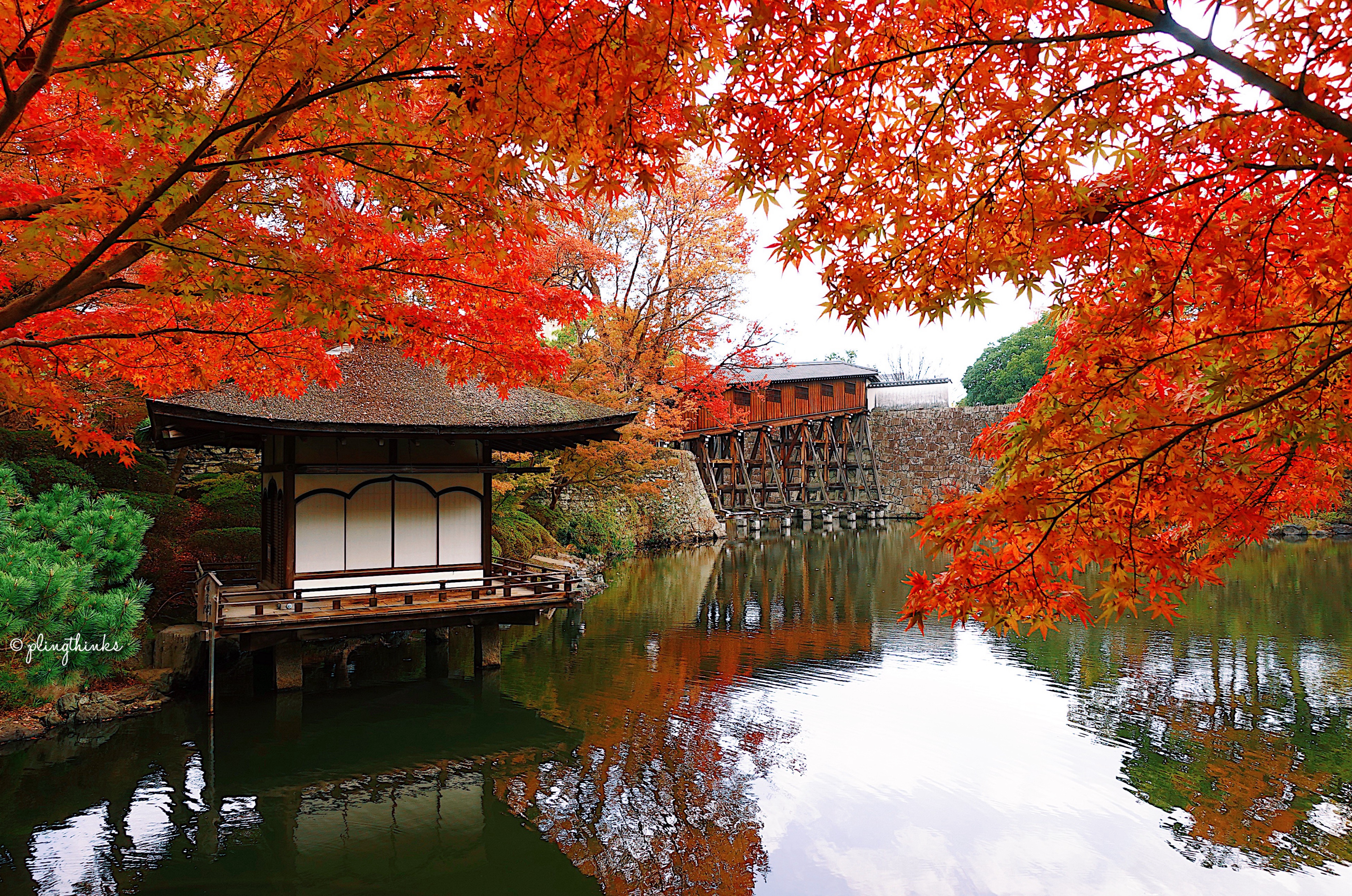
In autumn, the maples around the pond turned deep red and gold, and the water pulled the color down into a second, rippled version of the same view.


The garden was compact. We were elated that there was no long hike involved (little did we know what awaited us later on en route to Wakayama Castle) — just a slow loop around the pond, with a new angle on the pavilion and bridges at almost every turn.


A large stone in the pond in front of the bridge — the Boat Stone (ofuna-ishi 御船石) — anchored the whole composition. Its shape suggested a treasure ship sailing across the water, carrying good fortune, longevity, and peace.

The whole pond traced the shape of the Chinese and Kanji character for “heart” (心), a classical Japanese garden design known as shinji-ike (心字池), or heart-character pond.
2. Linger around Engyokaku Pavilion at the Heart of the Garden
The Engyukaku Pavilion (鳶魚閣) appeared to float on the garden’s pond, and it was the first thing that naturally pulled our eyes towards it when we stepped into Momijidani Teien.
Built to take advantage of the natural slope of Mount Torafusu, the whole garden was designed around this view — so find the spot across the water where the pavilion lined up against the trees behind it. It seemed that the garden was built to frame it in this particular way.

Its name was thought to come from a line in the Shijing (诗经), China’s oldest collection of poetry — “the kite flies to the heavens, the fish leaps in the depths” — a phrase about creatures moving according to their own nature and finding joy in it.
It was built as part of the Edo-period Nishinomaru Palace under the feudal lord Yorinobu Tokugawa (徳川頼宣) and served as a retreat where the domain’s rulers held tea ceremonies and other refined pastimes overlooking the garden.

The pavilion’s moat-facing windows are katōmado (花頭窓), the bell-shaped windows seen in traditional Japanese architecture, covered in shoji (しょうじ) paper, and the interior is a small 4.5-tatami-mat room once linked to the palace by a covered corridor.


3. Walk the Lord’s Private Corridor at Ohashiroka Bridge
Ohashiroka Bridge 御橋廊下 wasn’t like the other bridges in the garden. It was a fully enclosed, roofed corridor that once connected Nishinomaru (西之丸), the lord’s private leisure quarters, to Ninomaru Ōoku (二の丸大奥), his residential quarters — walls and a roof built to block the wind and rain, and to keep him hidden from view as he crossed. Only the lord and a handful of attendants were ever allowed to use it.


It was also built on a rare diagonal slope, following the difference in height between the two banks, with floorboards cut into a sawtooth pattern to stop feet slipping on the polished wood. We climbed it in our socks, having left our shoes at the entrance. The steps were at an slight angle and slippery underfoot, but thanks to those grooves, we made it without sliding downwards.


The bridge standing today is a 2006 reconstruction, based on surviving Edo-period drawings. Even from the outside, it’s one of the most photogenic structures in the garden, especially framed against the autumn leaves and Wakayama Castle.


4. Capture the Best View of Wakayama Castle
Leaving Momijidani Teien behind, the route to Wakayama Castle crossed back over Ohashiroka Bridge and passed through the ruins of Nishinomaru Palace, where the lord once kept tea houses for his leisure. Little of it survived above ground today — mostly open terrain and foundation traces.

From the ruins, the path joined Urazaka (裏坂), the “back slope,” pressed in close between the castle’s white plaster walls and blue-stone ramparts. The stone steps here were wide, but the climb was a real one, rising steadily until the path opened out near the keep. It’s the quieter of the castle’s 2 main approaches, the reverse of the grand front slope most visitors use to enter from the main gate.


Mt. Torafusu, on which the castle sits, has two peaks — likened locally to the humps of a camel. The tenshu (天守), the castle tower, stands on the higher western peak, while the lower eastern peak once held a palace, the Honmaru Goten (本丸御殿). It turned out too cramped and awkward to actually live in, so it sat largely empty for most of its history and was torn down in the Meiji period. All that’s left today is its former footprint — but stand on it and look across to the castle tower, and it’s the best vantage point.


5. Explore the Castle Grounds and Stone Ramparts
With the rest of the afternoon set aside for elsewhere in Wakayama, we skipped going inside the keep on this day trip. Even without going inside the keep, the grounds themselves were worth the walk. Stone ramparts wound around the base of the castle, built up over different periods as the site expanded under the Asano and then Tokugawa clans. Following the walls around gave a sense of the castle’s scale that was hard to get from photos of the keep alone.


6. Recharge with Mikan Soft-Serve
A mikan soft-serve made for a great stop without us ever leaving the castle grounds. The shop used fresh milk from nearby Kurosawa Farm (黒沢牧場), and we had the mikan jelly soft-serve made with Arida mikan (有田みかん), one of the most prized mikan varieties in the prefecture and ranked the shop’s most popular item.

The classic plain soft-serve might be worth a look too, topped with either a binchotan (備長炭) charcoal cookie or Wakaura senbei (和歌浦せんべい), a local rice cracker.

We paired our sweet tangy mikan soft-serve with a bag of Wakayama-limited potato chips flavoured with jabara (ジャばら), a rare citrus grown almost exclusively in the prefecture’s Kitayama village (北山村), blended into the chips as a powder alongside rice for extra crunch.
7. Pick Up Mikan Souvenirs to Take Home
Wakayama is one of Japan’s biggest mikan-producing regions, and the citrus flavor shows up everywhere locally. Before heading out, the shop was worth a further browse. Mikan showed up in many forms here — miso, sauces, juices, candies, snacks, and baked goods — making for an easy, unmistakably local souvenir.


My haul here included mikan jellies, yuzu miso, award-winning soy sauce, and mikan ponzu sauce. We also picked up a bag of mikan oranges to eat back at our accommodation at the station’s supermarket.

pling thinks…it’s a memorable half-day at Wakayama Castle and Nishinomaru Teien Garden — a day trip easily woven into a Kyoto (~2 hours by train) or Osaka (~1 hour by train) itinerary. From the maples of Momijidani Teien to the floating calm of Engyokaku Pavilion, the quiet secrecy of Ohashiroka Bridge and a well-earned mikan soft-serve at the end, the castle grounds hold enough on their own to fill a morning or afternoon — garden, history, and a proper local snack, all within a short walk of each other. It’s one of the those places in Japan where autumn colours, castle scenery, and citrus culture all show up in the same visit. Go at the end of November for peak momiji, bring an appetite for mikan, and don’t rush the garden — it’s the real reason to come.

How to get to Momijidani Teien Garden and Wakayama Castle
Nishinomaru Teien (Momijidani Teien)
〒640-8146 和歌山県和歌山市一番丁3 和歌山城内 3
Japan, 〒640-8146 Wakayama, Ichibancho, 3 和歌山城内 3
Open Daily: 09:00 to 17:00
(Last Entry at 16:45. Closed on 29 to 31 December)
Free Admission
From Wakayama Station:
1) Head to bus terminal just outside the station and take Bus 25.
2) Ride for 5 stops and alight at Shiyakusho Mae (市役所前).
From Osaka Station:
1) Take the Osaka Loop Line towards Wakayama.
2) Ride for 22 stops and alight at Wakayama Station
3) Head to bus terminal just outside the station and take Bus 25.
4) Ride for 5 stops and alight at Shiyakusho Mae (市役所前).
From Shin-Osaka Station:
1) Take the JR Kuroshio towards Wakayama.
2) Ride for 6 stops and alight at Wakayama Station.
3) Head to bus terminal just outside the station and take Bus 25.
4) Ride for 5 stops and alight at Shiyakusho Mae (市役所前).
From Kyoto Station:
1) Take the JR Tokaido-Sanyo Line towards Banshu-Ako.
2) Ride for 2 stops and alight at Shin-Osaka Station.
3) Change to JR Kuroshio towards Wakayama.
4) Ride for 6 stops and alight at Wakayama Station.
5) Head to bus terminal just outside the station and take Bus 25.
6) Ride for 5 stops and alight at Shiyakusho Mae (市役所前).
A Cheaper Alternative:
1) Take the JR Tokaido-Sanyo Line towards Banshu-Ako.
2) Ride for 3 stops and alight at Osaka Station.
3) Change to Osaka Loop Line towards Wakayama.
4) Ride for 22 stops and alight at Wakayama Station
5) Head to bus terminal just outside the station and take Bus 25.
6) Ride for 5 stops and alight at Shiyakusho Mae (市役所前).
There is front slope approach to Wakayama Castle if you would like to start with the casstle, instead of our route which was from Momijidani Teien via the back slope to the castle..
Wakayama Castle

〒640-8146 和歌山県和歌山市一番丁3−3
Japan, 〒640-8146 Wakayama, Ichibancho, 3−3
Open Daily: 09:00 to 17:30
(Closed on 29 to 31 December)
Entry fees: ¥410
From Wakayama Station:
1) Take Bus 25, ride for 6 stops, and alight at Wakayamajo Mae (和歌山城前). Or take Bus 41, ride for 4 stops, and alight at Wakayamajo Mae (和歌山城前).
2) Walk upwards and towards Wakayama Castle for about 10-15 minutes.