
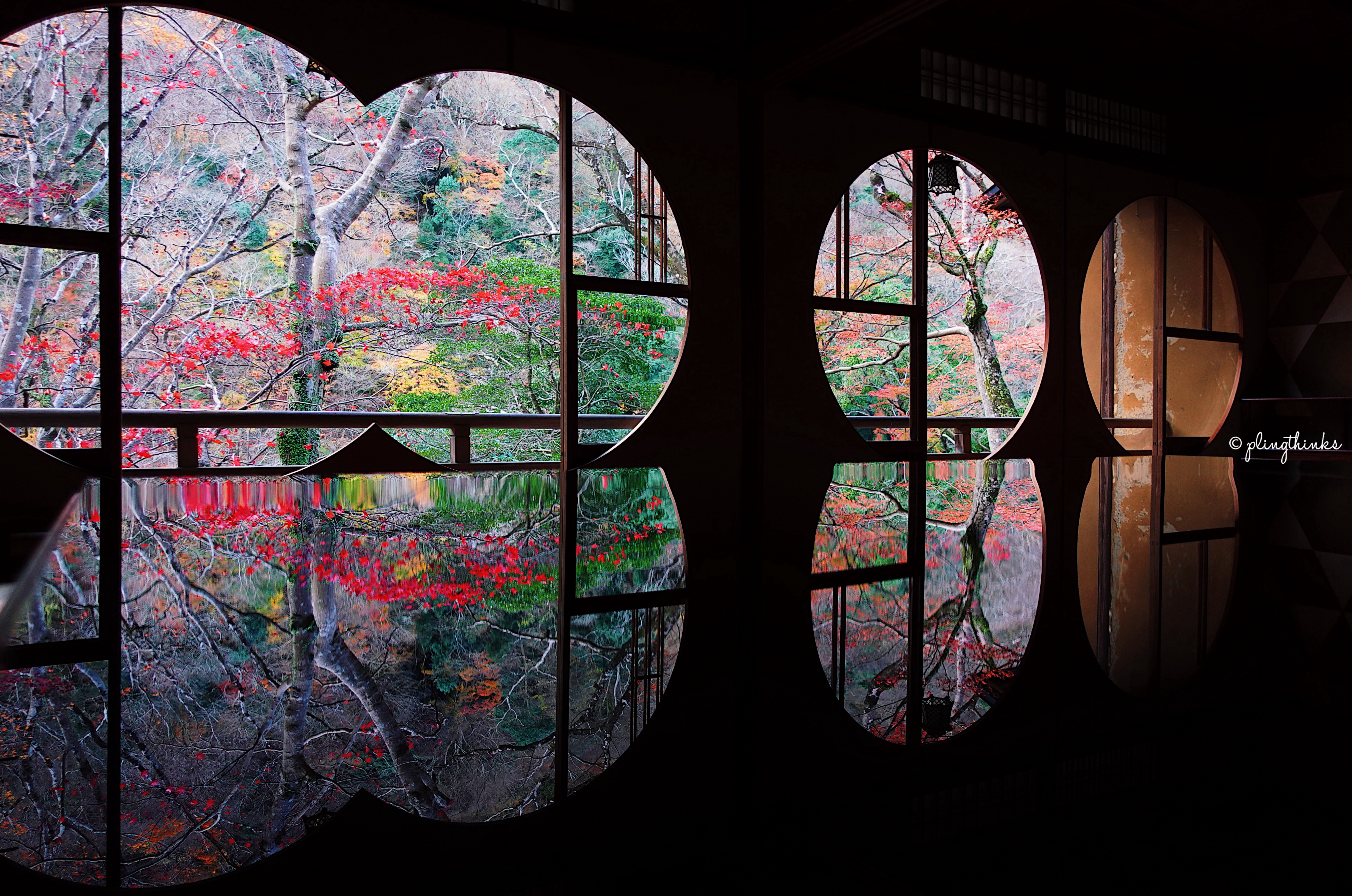
Along the banks of the Katsura River in Arashiyama, a short uphill climb leads to a small gallery easy to miss if you’re not looking for it. Arashiyama Yusai-Tei 嵐山 祐斎亭 doesn’t announce itself with grand signage or a crowd outside the door — but climb up the stone stairs, step inside, and it’s a little art, a little wonder, and a lot of windows.
Light pours through striking windows and shoji cut-outs, walls of hand-dyed kimono and scarves in colour so vivid it stops you mid-step, and if you’re lucky, you might even catch the master dyer at work. When I visited by late autumn, the last of the season’s red leaves lingered just outside, adding a final touch of colour to the visit. It’s a small space, but one that rewards the curious.
1. Gallery Entrance That Feels Like Stepping Into a Village Home

Near the tail end of the path along the Katsura River (桂川), well away from the crowds at Togetsukyo Bridge (渡月橋), a small wooden board marks the base of a flight of stone stairs leading uphill. It’s easy to miss if you’re not looking for it — no big signage calling out to passersby to suggest what waits at the top.
The climb was short but a little steep to slow my pace, ending at a modest wooden entrance that felt more like arriving at someone’s village house than a gallery. Just inside, I removed my shoes, tucking them into a clean plastic bag provided at the door to carry along for the rest of the visit.


2. Kawabata Yasunari’s Room
In a room named after Nobel laureate Yasunari Kawabata (川端康成) at the entrance’s left, autumn foliage stretched out in a panoramic view. It’s said that Kawabata once stayed in this very room and wrote part of his novel The Sound of the Mountain (山の音, Yama no Oto) here, a detail that lends the space a quiet literary weight. Fittingly, the novel’s events themselves begin and end in autumn — the very season I found myself standing in that room.


3. Framed by Windows: Yusai-Tei’s Signature Views
The gallery’s real draw became clear the moment I stepped inside, where 3 distinct windows and shoji each offered a completely different way of seeing the scenery outside and across the Katsura River.
The Shoji Screen Doors

Near the entrance, a set of shoji (しょうじ or Japanese sliding screen doors) was cut with tall, vertical rectangular openings, letting in the scenery and bands of light that fell across the floor in long, graphic lines. As the sun moved throughout the day, these shadows shifted and stretched, turning the simple screen into a quiet, ever-changing pattern.
Round Windows Room
Deeper into the gallery, two sets of round windows took centre stage in a single large room — and it was easy to see why they are the gallery’s biggest draw.

The windows’ circular frames offered a completely different rhythm from the shoji earlier: more contemplative and almost like looking through a giant lens onto the world outside. By the end of autumn, the last flashes of red foliage framed themselves perfectly within the circles, turning each window into something close to a living painting.

The Reflective Table
Beneath each set of round windows sat a polished, mirror-like black table, positioned to catch a perfect reflection of the view above it — a detail as deliberate as the windows themselves.


Staff periodically wiped the surface clean throughout the day, keeping it spotless enough for visitors to lean in and photograph the mirrored scenery without a smudge or fingerprint breaking the illusion. It was a small touch of hospitality that could easily go unnoticed, but it was exactly what made the reflective, near-symmetry in every photo look effortless.


4. Stepping into Colour: Dyeing Art Gallery and A Master’s Legacy
Deeper into the gallery, kimonos, scarves and fabrics revealed the true scope of the space’s work — dyed by hand in colours ranging from soft, muted tones to bold, saturated hues. Behind every piece on display was decades of innovation. In 1990, Master dyer Yusai Okuda (奥田 祐斎) unlocked the secrets of Korozen (黄櫨染), a colour-changing dye once reserved exclusively for the emperor’s formal garments, and developed it into his own technique, Yume-Korozome (夢黄櫨染), whose hues shifted and changed with the sunlight throughout the day. His work has since been recognised internationally, including an exhibition at the Musée du Louvre in 2008.

As I walked in a slow semicircle around this kimono on display, the maple leaf patterns seemed to shift with every step — colours deepening, fading, and catching the spotlight differently depending on where I stood.

I was lucky and observed a dyer at work in an adjoining workshop. Quietly maintaining a respectful distance, watching him work added a layer of appreciation to the gallery that photographs alone couldn’t capture — a reminder that everything here was handmade, one careful step at a time.
5. Terrace Overlooking Katsura River
Past the main gallery, a wooden pavilion opened onto a terrace that looked out over the Katsura River and the hills beyond. Overhead, rows of persimmons hang drying in the open air, their slightly oval orange shapes catching the eye at first glance like a string of bare light bulbs before revealing themselves as fruit, left to slowly dry in the autumn sun and air.


In late autumn, the water below took on an almost emerald hue, a striking contrast against the reds, oranges, and yellows of the surrounding maples. Across the river, Mount Ogura (小倉山) rose quietly in the distance, its slopes catching the last of the season’s colours. It was a small, unhurried moment built into the visit — a place to simply sit, breathe, and take in the view, a reminder that Yusai-Tei wasn’t designed to be rushed through.

I did catch a glimpse of master dyer Yusai Okuda-san when he was taking a rest at the terrace, overlooking the river and the mountains.
6. Painting with Leaves and Water: A Hands-On Moment

Just outside and to the right of the terrace, a small hands-on activity invited visitors to create their own miniature scene, set up in 2 parts.
The first was a large, shallow water tray, positioned to catch a mirrored reflection of the autumn foliage and Mount Ogura across the river. The water was rarely still — a gentle autumn breeze sent quiet quivers rippling across its surface, softening the reflection into something closer to a watercolour than a mirror.


Just beside it, a narrow table bench with stones and a handful of fallen maple leaves — reds, oranges, and yellows — invited visitors to arrange on the dark table however they like. A spray bottle stood ready nearby for adding the finishing touch by misting the waxed table surface and maples to catch the light and heighten the colour just before the photo.

I found the simple activity a quietly gratifying and immersive one — a chance to play and create a small, personal piece of the season, framed against the very scenery that inspired it.

pling thinks…Arashiyama Yusai-Tei is a gallery built on deliberate moments. From the short climb that feels like arriving at someone’s mountain home to the rippling reflections on the balcony’s activity area, it is a place where light, windows, and decades of dyeing craft come together in a space that rewards a visit. The windows here, especially set against the autumn colours outside, are grand enough to draw a crowd of their own, so it’s worth being mindful of others waiting for their own moment in front of them. For those willing to share the space graciously, Yusai-Tei offers something increasingly hard to find in Kyoto’s most photographed corners: a chance to quietly admire, creatively play, and simply let a small space leave a lasting impression.

Right nearby, Wabunka offers Kyoto kappo (割烹) meal at the renowned Arashiyama Kumahiko (嵐山熊彦) — a chef-led dining experience where seasonal dishes are prepared and served right in front of you. An optional private rickshaw tour adds a scenic, old-world finish to the day, gliding past Arashiyama’s sights from a rider’s view.

Photo courtesy of Wabunka
How to get to Arashiyama Yusai-Tei Gallery
〒616-8386 京都府京都市右京区嵯峨亀ノ尾町6
6 Sagakamenoocho, Ukyo Ward, Kyoto, 616-8386, Japan
Open Fridays to Wednesdays (closed Thursdays): 10:00 to 17:00
Check website in case there are changes due to weather conditions or seasonal closures.
Entry fees: ¥2,000
As the gallery space can be limited, it does get really crowded during peak autumn colours and other busy travel seasons, so reserve your tickets here to secure your visit.
From Kyoto Station:
By Train
1) Take the JR San-In Train towards Sonobe.
2) Ride for 7 stops and alight at Saga-Arashiyama Station.
3) Walk towards Togetsukyo Bridge (渡月橋) and turn right before the bridge crossing.
4) Walk along Katsura River (桂川), past a small eatery hut, and you’ll see the sign above.
By Bus
1) Take City Bus 28 at the Kyoto Station bus terminal.
2) Ride for 27 stops and alight at Arashiyama Koen (嵐山公園).
3) Walk across the Togetsukyo Bridge.
4) Turn left and walk along Katsura River, past a small eatery hut, and you’ll see the sign above.
*Affiliate links – plingthinks may earn a small commission from qualifying reservations made through these links, at no extra cost to you.*
Pingback: Bamboo Groves // Arashiyama | plingthinks
Pingback: 7 Autumn Sights at Okochi Sanso Garden // Kyoto Arashiyama Villa Many Walked Past | plingthinks
Pingback: Katsura River // Arashiyama | plingthinks