
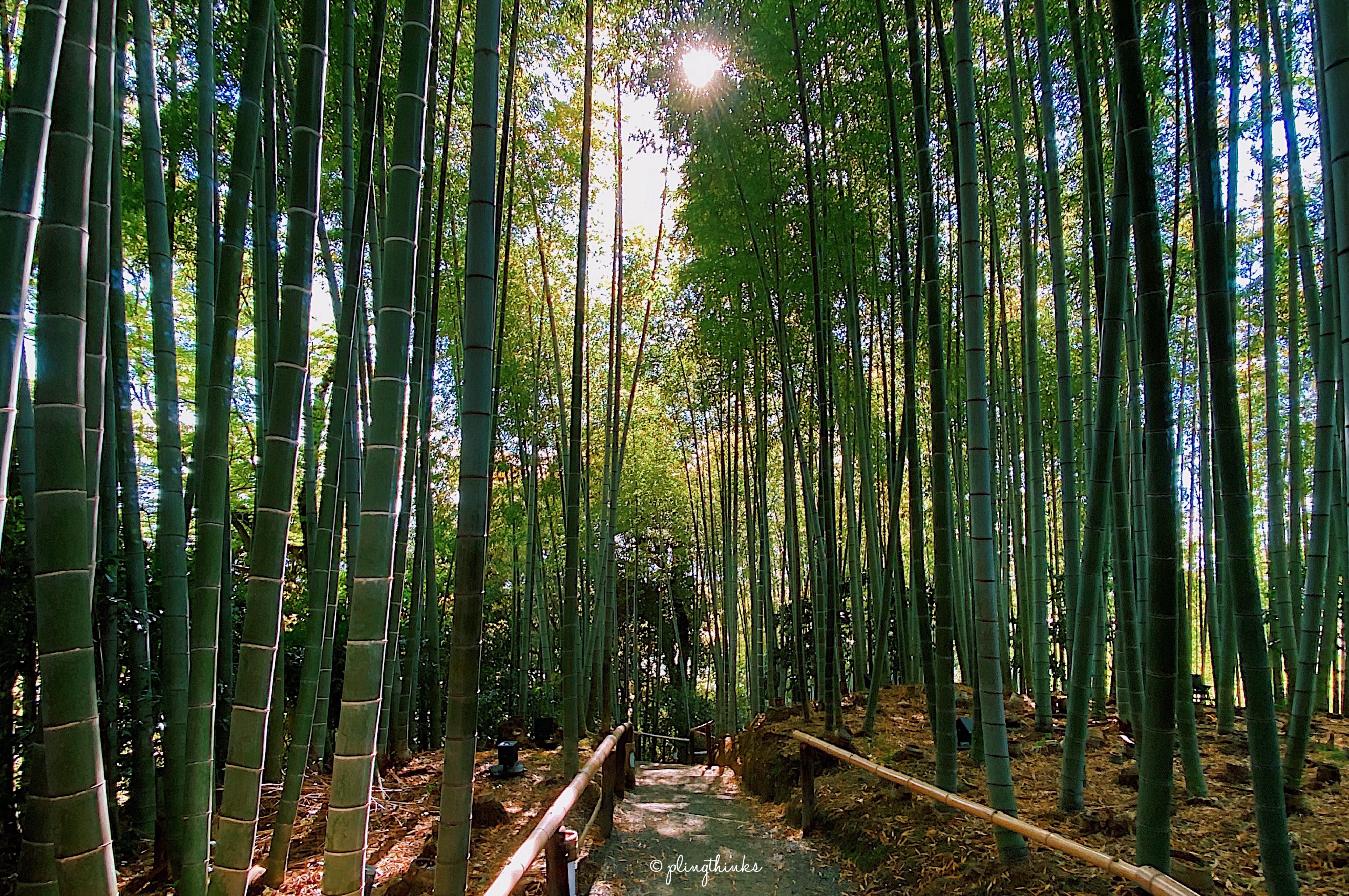
Most visitors to Kyoto head straight for Arashiyama when they think of bamboo forests, cameras ready for that famous green tunnel. But tucked into the Higashiyama hills (東山), within easy walking distance of Kiyomizu-dera (清水寺) and Gion (祇園), Kodai-ji 高台寺 hosts a bamboo grove of its own — less crowded, and in some ways, more atmospheric. The temple unfolds through rock gardens, teahouses, and its subtemple Entoku-in 圓徳院, before leading to long stretches of bamboo that forms its own tunnels, where the only sound is the rustle of leaves overhead and the creak of bamboo stalks swaying in the wind. Here are 7 things worth slowing down for, saving the best for the last.
I didn’t come looking for quiet or healing here, but I found it anyway — in the light threading through the bamboo forest in Kodai-ji, the rustling sound of leaves as the wind moved through the stalks, and the soft brush of that same breeze against my skin.
1. Enter Through a Tunnel of Green

The approach to Kodai-ji begins along Nene no Michi (ねねの道), a stone-paved promenade lined on both sides with shops and restaurants, named after the temple’s founder.
From there, a stone stairway called Daidokoro-zaka (台所坂) leads upward, trees arching overhead on both sides to form a tunnel-like canopy over the climb. It was an unhurried ascent — a soft slope rather than a steep one — giving us time to notice the shift in atmosphere as the street sounds faded behind us.

Kodai-ji was founded in 1606 by Kita-no-Mandokoro (北政所), better known as Nene (ねね), the widow of the warlord Toyotomi Hideyoshi (豊臣秀吉). After his death in 1598, she devoted herself to building a temple in his memory, funded by his successor, Tokugawa Ieyasu (徳川家康). By the time I reached the top of the stairs, it was easy to sense that the calm, orderly grounds ahead were born from personal loss — a widow’s tribute that would go on to shape one of Higashiyama’s most significant temples.
2. Spin the Mani Wheels and Spot Gionkaku Tower
Near the start of the path, visitors will find a row of mani wheels — cylindrical prayer wheels inscribed with the sacred Heart Sutra. Some visitors could be seen giving each one a spin with their right hands as they walked clockwise around the hall. It was a small, tactile ritual that invited the participation of wishing for health rather than passive viewing. It was a simple moment of observation for me, but one that set a reflective tone for the rest of the visit.

From certain points along the grounds, the distinctive form of Gionkaku Tower (祇園閣), part of the nearby Daiun-in Temple (大雲院), rose above the trees in the distance. Drawing inspiration from the ornate floats of the Gion Festival (祇園祭), the roof really caught my eyes — a striking copper structure topped with a slender column and crowned with a crane spreading its wings, giving the pagoda-like tower a silhouette unlike anything else on the skyline. It was an unusual sight that offered a striking architectural contrast against Kodai-ji’s more understated architecture and a brief, elevated view before the path continued deeper into Kodai-ji temple grounds.


3. Wander Through Kodai-ji’s Two Gardens
Kodai-ji is home to 2 contrasting gardens, both shaped in part by the renowned landscape designer Kobori Enshu (小堀遠州).
The Zen Rock Garden

Beside the main hall lies Hashin-tei (波心庭), a Zen rock garden of carefully raked gravel representing a vast ocean. At its edge stands a single, dignified weeping cherry tree, its branches trailing gracefully alongside the Imperial Envoy Gate (Chokushimon 勅使門) and right in front of the katōmado (花頭窓), the bell-shaped window of the abbot’s chamber.


Now in its fourth generation on this same spot, the tree draws crowds each spring with its sakura splendour. Even in its green, bare, or autumn form, its silhouette against the rippled gravel makes for an elegant scene.


The stark simplicity of the rock garden offered a peaceful reprieve before I continued on.
The Tsukiyama-Style Garden
The second garden takes a more layered, dimensional approach, built around 2 ponds — Engetsu-chi (Full Moon Pond 偃月池) and Garyu-chi (Crouching Dragon Pond 臥龍池) — along with man-made hills, a tranquil pond, decorative rocks, and pine and maple trees that turn brilliant shades of red and orange in late autumn.

Engetsu-chi holds a turtle-shaped island bordered by ambitious stonework. Best admired from Kangetsudai (観月台), the covered bridge and moon-viewing pavilion which was built by Hideyoshi and moved from Fushimi Castle (伏見城), the elevated vantage point frames the hills, ponds, and autumn colours together in a single sweeping view. However, the bridge wasn’t open for visitors to walk across when we visited.

Garyu-chi features a crane-shaped island. I could imagine its still water catching the reflection of autumn foliage when the leaves turn into their vivid colours.


Arching alongside the pond is Garyu-ro (臥龍廊), a covered wooden corridor connecting Kaizando Hall to the mausoleum, its long, curving form said to resemble the back of a dragon, lending the pond its name. Visitors can’t walk across it, but its striking silhouette, especially when framed by autumn colours, makes it one of the most photographed spots in the entire garden.

4. Admire Kaizando Hall, Nene’s Former Home
Kaizando Hall (開山堂) is one of the few original structures to survive a fire that destroyed much of the temple complex in 1789. Designated an Important Cultural Property, it’s believed to have originally served as Nene’s own living quarters, later moved here from Fushimi Castle after Hideyoshi’s death.

I admired the fine maki-e lacquerwork (蒔絵) Kodai-ji is known for alongside paintings on the walls. As photography wasn’t permitted inside, the details were best taken in with my eyes at that moment.

Stepping out through a side exit, the view opened onto Garyo-chi and its border of azalea shrubs, creating a frame around the pond that offered a moment of stillness.

5. Discover Two Historic Teahouses
Slightly higher up the hillside sat two rustic teahouses, Kasa-tei (傘亭) and Shigure-tei (時雨亭), both relocated from Fushimi Castle and traditionally attributed to the legendary tea master Sen no Rikyu (千利休). Visitors couldn’t step inside, but their designs were easy to take in from the path.
Kasa-tei takes its name from its bamboo ceiling, arranged like the ribs of an open umbrella, while Shigure-tei is a rare and interesting example of a teahouse with a second story. This was the first time I had seen a 2-storey ancient traditional teahouse in my many travels to Japan.


The two are joined by a covered, packed-earth walkway, its simple roofline echoing the rustic materials of the teahouses themselves. Together, they offered a glimpse into the tea culture of the Momoyama period, even from a respectful distance.

6. Listen to the Whispers of Kodai-ji Bamboo Forest
I could hear the bamboo forest before I even reached it — a soft rustling drifting towards me along the stone path just past the historic teahouses, growing louder with every step as I walked towards the exit.

The path led into a long grove of bamboos, their tall stalks forming natural tunnels overhead. Compared to the busier bamboo forest in Arashiyama, this felt noticeably quieter and less crowded, letting the atmosphere take over: soft whispers of leaves brushing against each other, the gentle creak of stalks swaying in the wind, and filtered light falling in narrow beams through the canopy.


I made sure to walk carefully along certain parts of the path — the steps followed the natural incline and contours of the forest, so their width and height varied, with some steeper or narrower than others.

I didn’t come looking for quiet or healing here, but I found it anyway — in the light threading through the bamboo forest in Kodai-ji, the rustling sound of leaves as the wind moved through the stalks, and the soft brush of that same breeze against my skin. For a long while, I just stood in that long tunnel of towering bamboo, letting it all wash over me.


The less hurried pace meant I could actually stay a while — enjoying the sound therapy, the movement of the leaves, and the breeze drifting through the bamboo, rather than rushing through for a quick photo or to get away from the crowd. For me, it was the most healing stretch of the entire visit.
7. Stop By Entoku-in, Nene’s True Home

Just beyond the main grounds lies Entoku-in 圓徳院, a subtemple that holds particular significance: after Kodai-ji’s founding, Nene didn’t actually live within the main temple itself, but moved into Entoku-in, spending the last 19 years of her life there until her death in 1624.


Entoku-in hosts 2 Zen gardens. Once the front garden of Nene’s own residence, the North Garden is designated a National Place of Scenic Beauty and is said to have the most beautiful rocks and stones gathered from across Japan for the much beloved Nene.


On the other hand, the South Garden’s raked white sand traces the shape of the sea and offers a contemplative counterpart to the bolder North Garden.


Inside, visitors can also stop for matcha and a traditional sweet at the temple’s tearoom for ¥500, a simple, unhurried way to close out the visit.
It’s a fitting final stop — a chance to stand in the very place where Nene spent her final years, watching over the temple she built for her husband’s memory.

pling thinks…Kodai-ji is a different kind of wonderful. From the green canopy at the entrance to the devotion held within Entoku-in, Kodai-ji rewards patience — a place built not for quick photos, but for slow walks, close looking, and intentional listening. Every corner carries a trace of Nene’s story, from the gardens shaped in her memory to the home where she spent her final years, giving the visit a personal, almost intimate weight.
If there’s one part of Kodai-ji I’d urge you not to rush through, it’s the bamboo forest. Calmer and far less crowded than its famous Arashiyama counterpart, it’s the kind of place that asks you to simply stop, listen, and let the wind do the rest. I felt embraced in that long tunnel of green bamboo as I listened to the music that only nature can make. In a city full of must-see sights, Kodai-ji is proof that some of Kyoto’s best moments are the unhurried ones.

How to get to Kodai-ji and Entoku-in

〒605-0825 京都府京都市東山区 高台寺下河原町 526
Japan, 〒605-0825 Kyoto, Higashiyama Ward, 高台寺下河原町 526
Open Daily:
Kodai-ji Temple: 09:00 to 17:30 (Last entry 17:00)
Entoku-in Temple: 10:00 to 17:00

Entry Fees:
Combined entry to Kodai-ji and Entoku-in: ¥1,200
(My visit included a goshuin 御朱印 souvenir with the combined entry purchase.)
Kodai-ji Temple only: ¥800
Entoku-in Temple only: ¥500

From Kyoto Station:
1) Take the 86 or 206 City Bus from the bus terminal.
2) Ride for 9 stops and alight at Higashiyama Yasui (東山安井) bus stop.
3) Cross the road and walk along Higashioji-dori (東大路通), then turn left into Kodai-ji Minami-mon dori (高台寺南門通り) and turn left into Nene no Michi (ねねの道). The walk is about 7-10 mins.
Follow the map link above to walk from Gion and Kiyomizu-dera (8-15 mins).
Pingback: Bamboo Groves // Arashiyama | plingthinks